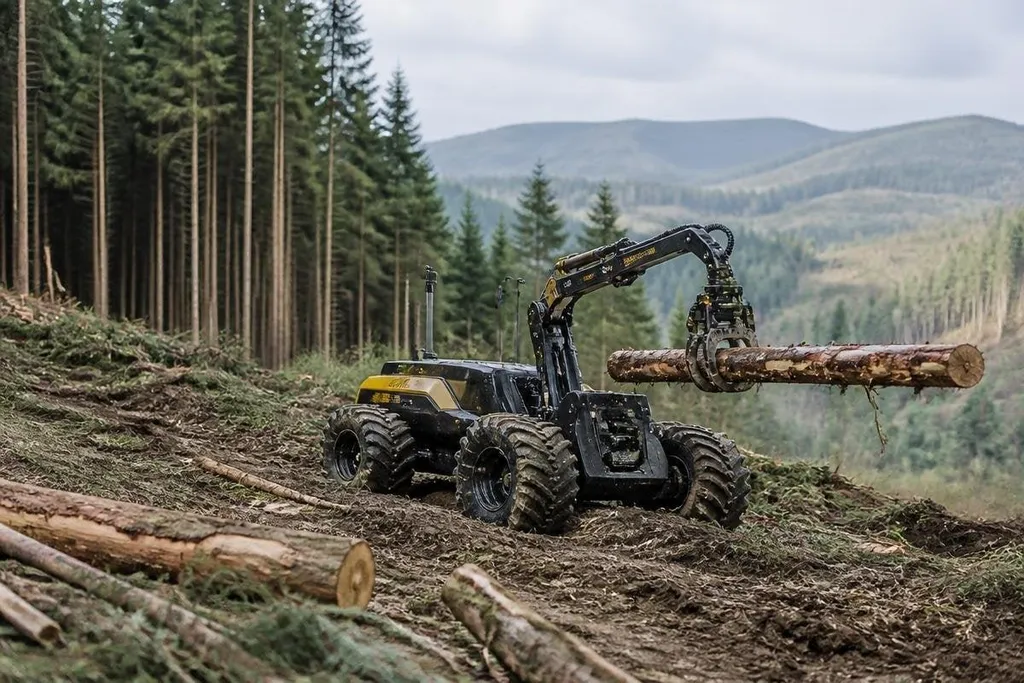
Forestry robots work where people face steep ground, falling timber, heavy loads, and moving blades. Their value comes from taking on specific tasks, but each task brings new safety, cost, and control problems.
- Robots can inspect trees, carry loads, cut timber, or clear debris.
- LiDAR, cameras, and satellite positioning help machines read the work area.
- Remote control does not remove the need for trained operators or site checks.
Where forestry robots can help
A forestry robot can take on work that exposes people to falling branches, unstable slopes, and machines such as harvesters or chainsaws. The benefit depends on the task: a robot that carries cut timber has a different safety case from one that cuts trees.
Inspection is one practical use. Cameras and LiDAR can record trunks, paths, damaged trees, and ground conditions without sending a person into every section of a site. The records can help a crew decide where to walk, what to remove, and which areas need a closer check.
Transport is another use. A tracked machine can carry tools, fuel, or logs across ground that would be slow or tiring for a person to cross. That may reduce manual lifting and keep workers farther from active cutting areas, but the machine still needs a clear route and a safe stopping distance.
Some systems may also support planting, brush cutting, or site cleanup. Each task needs its own test because soil, roots, rain, slopes, and loose timber can change how the machine behaves.
The main risks
Wet ground can make a forestry robot lose traction or slide on a slope. A heavy machine can also damage soil, roots, or young trees when it turns. These are physical limits, not software settings that disappear after an update.
Cutting creates a higher risk. A saw, mulcher, or arm can strike a person, branch, rock, or buried object. The robot needs reliable detection, a clear stop command, and a work plan that keeps people outside the machine's danger zone.
Remote operation adds another weak point. The operator may see a camera feed instead of the full site, while trees, hills, dust, and rain can block signals or hide hazards. A delayed video feed can make a moving arm harder to control near people or equipment.
Autonomy brings a separate concern. A robot may follow a planned route, but the forest changes from one metre to the next. Fallen branches, animals, loose soil, and unexpected workers can all break the assumptions behind that route.
What a safe system needs
Safety starts before the robot reaches the site. The owner needs to define the task, map the work area, mark exclusion zones, and decide who can stop the machine.
The plan also needs a response for lost communications, low battery, sensor failure, and a person entering the work zone.
The machine should make its state easy to read. A worker needs to know whether the robot is idle, moving, waiting for an operator, or able to start a cutting tool. A physical emergency stop should remain reachable for the people working near the machine, not only for someone watching a screen.
Training matters too. An operator needs to understand the robot's drive system, payload, slope limits, battery state, and tool controls. A person who can move the robot is not automatically ready to manage a forestry site.
A forestry buyer needs reports that name the slope, load, battery state, and operator action behind each forest trial. Forestry robotics reporting from Robot24.com can show whether a machine’s claim holds outside a controlled demo, which leads to the limits that remain unproven.
What remains unproven
The hardest question is not whether a robot can move through trees. A short test can prove that. The harder test is repeated work across changing ground, weather, signal quality, and crew routines.
Costs also go beyond the purchase price. A forestry operator may need transport, spare tracks, batteries, software support, training, insurance, and a person who can recover the machine after a fault. A robot that needs constant remote help may shift labour rather than cut it.
I'd avoid buying a cutting robot until the maker publishes clear limits, stop behaviour, maintenance needs, and results from work outside a prepared test area.
A practical buying checklist
Before choosing a forestry robot, check these points with the maker and your own crew:
- Task limits: Confirm the exact work the robot can do, including ground slope, load size, tool type, and operating distance.
- Stop response: Test the emergency stop, remote stop, obstacle response, and behaviour after a lost signal.
- Site damage: Check turning radius, ground pressure, traction, and the risk to roots or young trees.
- Human access: Set rules for workers, visitors, vehicles, and animals entering the work zone.
- Support needs: Price training, batteries, transport, repairs, software support, and recovery equipment.
- Proof: Ask for dated test results from real forest ground, not only a cleared demonstration area.
The next useful proof will come from long work periods on wet slopes with normal crews nearby. Until makers publish those results, forestry robots make the most sense for inspection, transport, and other tasks with clear limits.